Inside the studio, time settles like dust or heat, under the hard glare of a single lamp. The young man sitting there looks detached from ordinary details of biography. In that light, he becomes sharper and more abstract: ribs, throat, hip, shadow, breath. His body is turned into a landscape of lines and weight. And yet, even in stillness, he cannot fully become an object. The body keeps living. It keeps warming the room, lifting and lowering with breath, refusing to disappear into mere form.
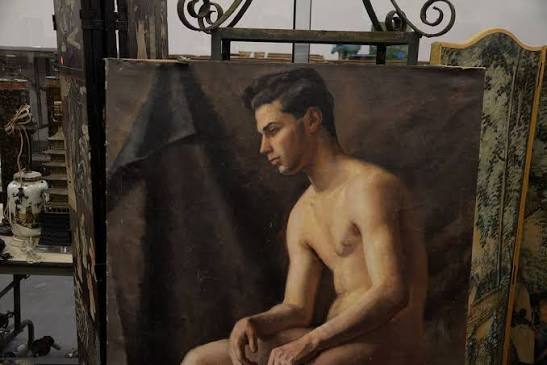
That is the strange contract of live modeling. It sits somewhere between art, commerce, and vulnerability, without ever fully belonging to any one of them. The artist looks with a kind of disciplined intensity, measuring the body against canvas, treating flesh as if it could be translated into line and color. John Berger’s distinction between the naked and the nude matters here: the naked body is simply itself, while the nude body is the body made available to the gaze. In the studio, that transformation is always in motion.
But looking is never as clean as it seems. To observe a body for hours is not a neutral act. Attention begins as technique, then slowly takes on a charge of its own. The artist may try to keep desire out of the room, to turn the body into structure and light, but some of the human heat always remains. It enters the atmosphere. It gives the work its tension. Without that hidden pressure, the painting would risk becoming too neat, too clinical, too dead.
What makes the studio moving is this unstable balance. The model offers nakedness, but not complete surrender. The artist seeks form, but cannot entirely escape feeling. Between them is a silence that is both professional and intimate, both protected and exposed. The final image is a record of anatomy. It is also a trace of the encounter itself — of the fact that one person had to sit still while another tried to make meaning out of flesh, and that neither could fully avoid the force of being seen.


No comments:
Post a Comment